Courses/AI Kitchen/Episode 8
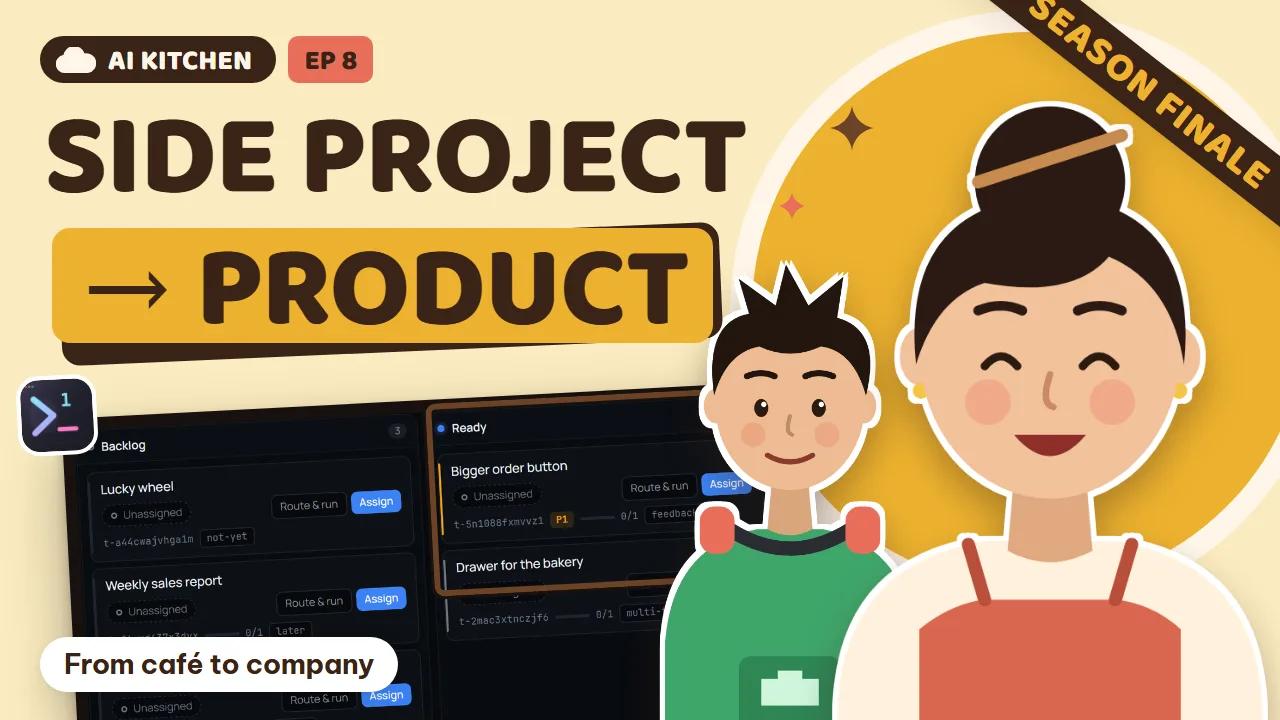
From Café to Company
Season finale. One app for many cafés, the real AI bill, several accounts at once, feedback into tasks, a roadmap, and Lan teaches Bin his first app.
Three other cafés want Lan's app. She turns it into "Mây", a small product for many shops, reads the real AI bill against the original 20-million-đồng quote, runs several AI accounts at once, turns customer feedback into tasks, plans what to build and what not to, and finally sits in Tú's seat to teach Bin his first app.
24 new words, from Product to Onboarding. Honest note: most side projects don't become companies, and that's fine. The skill you gained is the win.
What you will learn
- Multi-tenant SaaS: one app, a drawer for every shop
- Per-shop settings and branding
- The real cost of an AI team: analytics, usage and quota
- Several AI accounts at once
- Turning customer feedback into tasks, and planning a product roadmap
- Teaching the next beginner
- Product
- something many people pay for
- Customer
- someone who pays to use it
- Multi-tenant
- one app shared by many shops
- Tenant
- one shop, one private drawer
- Config
- each shop's own settings
- Branding
- a shop's colors, logo and voice
- Template
- a reusable mold
- Usage
- how much you've used
- Cost
- what you pay
- Analytics
- a ledger that writes itself
- Pricing
- how you set your price
- Account
- a membership card for an AI company
- Quota
- uses per time window
- Subscription
- a plan you pay monthly
- Feedback
- what customers tell you
- Support
- helping customers when stuck
- Churn
- customers quietly leaving
- Roadmap
- the map of what comes next
- Priority
- what goes first
- Version
- one numbered edition
- Release
- handing it to customers
- Changelog
- the list of what's new
- Mentor
- someone who guides the next person
- Onboarding
- a newcomer's first steps
Task: Ask your agent: what would change if your app served 3 shops? Ask for a plan only, no code changes yet.
Plan how to make this app multi-tenant for several shops. Split it into tasks, each with acceptance criteria. Do not change any code yet.
Task: Write an “add a new shop” skill: list what the agent must ask and what it must create.
Write a skill called add-new-shop: ask for the new shop's name, colors, logo and menu, then create that shop's config.
Task: Open Analytics in 1DevTool, pick 30 days, and find the session that used the most tokens.
Task: Open Accounts & Quota, see which account has the most left, and when it resets.
Task: Ask 3 real users one question: “What annoys you most?” Then turn each answer into a task.
Task: Sort your ideas into 3 columns: Now, Next, Not yet. At most 3 items in Now.
Task: Guide a friend through their first app in 15 minutes. You only talk; they type.
Generated from the episode’s subtitles. Click a line to jump there.
Tu: Last time, Cloud Café opened up to the real world: online payments, customer accounts, its own domain, and even its own server.
Lan: And I learned how to keep customer data private. Very grown-up stuff.
Thảo · bánh mì: Lan! I'm Thảo, from the bánh mì stall at the end of the alley. All my customers keep showing off your loyalty card. So I have to ask: can I buy your app? I will pay properly.
Lan: Buy my app? I only made it for my own café.
Lan: Tu, three shops asked the same thing this week. A bánh mì stall, a bubble tea shop, and a bakery.
Tu: Then you already have customers. The question now isn't whether you can do it. It's whether you should, and how to do it well.
Lan: In episode one, I didn't even know what code was. Now people want to buy my software.
Tu: The season finale has eight chapters: turning the café app into a product for many shops, counting the real costs, listening to customers, and choosing what to build. And in chapter seven, you'll sit in my chair. You'll teach someone else.
Lan: Me? Teach who?
Tu: Review from last time: what's production?
Lan: The real kitchen, serving real guests. Staging is the test kitchen, where it's fine to burn things.
Lan: I've got a plan: each shop gets its own copy of the app. One for bánh mì, one for bubble tea, one for the bakery.
Tu: That works at first. But every bug fix means fixing it three times, in three places. Ten shops, ten times.
Lan: So what do I do?
Tu: When something you made is paid for and used by many people, it becomes a product. The people who pay are your customers. And building one app that many shops share is called multi-tenant. Each shop is a tenant, someone renting a space.
Tu: Picture a big cabinet. The cabinet is the app. Each shop has its own drawer, with its own lock. The bánh mì stall's order book lives in the bánh mì drawer. The bubble tea shop opens its own drawer and never sees anyone else's.
Lan: Fix the cabinet once, and every drawer gets the fix. Brilliant.
Tu: The lock matters most. Showing one shop's orders to another is a very big deal. Remember last episode's privacy lesson.
Lan: What if I change one thing and break all three shops at once?
Tu: Then do what we did in episode seven: change it in the test kitchen first, taste it carefully, and only then take it to the real kitchen.
Lan: Three shops are trusting me, so I taste three times as carefully.
Lan: Head chef, I want the café app to become an app for many shops. Make a plan first, don't start cooking yet.
AI Head Chef: Sure. I suggest seven tickets. The most important one: every order records which shop it belongs to, and each shop can only read its own orders.
Lan: Approved. Add one line to what done means: logged in as the bánh mì stall, you can't see a single Cloud Café order.
Tu: The seven tickets land on the Tasks board, just like in episode two. Each one has acceptance criteria and an owner. The ticket that checks the locks between drawers goes to the most careful taster.
Lan: The more important the dish, the more careful the taster.
Tu: New words this chapter: product, customer, multi-tenant, and tenant.
Tu: Try it now: ask your chef what would need to change if this app served three shops. Ask for the plan only, no cooking yet.
Chapter 2: Every shop, its own style
Tu: Quick review: what's multi-tenant?
Lan: One cabinet, with a locked drawer for each shop. Fix the cabinet once, and every drawer gets it.
Thảo · bánh mì: Lan, the app is lovely, but it's all coffee brown. I sell bánh mì. I want a crispy golden yellow, with a baguette logo.
Lan: And the bubble tea shop probably wants pink. The bakery wants cream.
Thảo · bánh mì: Just please don't make me type code. All I know is baking bread.
Tu: Each shop gets its own settings sheet, called a config: the shop's name, colors, logo and menu. The app reads it and changes its look by itself. The colors, the logo and the way a shop talks to its guests are together called branding.
Lan: And the shared mold for making a new shop, I bet that's a template. Like a flan mold: one mold, as many flans as you want.
Tu: Wait, you came up with your own kitchen metaphor. A flan mold. I need to write that down. Here is one app with three configs. The three shops look completely different, but inside they share one cabinet.
Tu: Remember the house recipe book from episode four? We add one more recipe card: opening a new shop. That card is a skill. Any chef who reads it knows what to do: ask for the shop's name, colors, logo and menu, then create a new drawer and a new config.
Lan: Write it once, and the tenth shop gets done the same way. Nobody has to repeat themselves.
AI Head Chef: I've created a new drawer for Thảo's Bánh Mì. The default menu comes with one item: white coffee.
Thảo · bánh mì: I sell bánh mì!
Lan: Oh, just leave it. Bánh mì and white coffee go together.
Tu: New words: config, branding, and template.
Tu: Try it now: write a recipe card for adding a new shop. What the chef must ask, and what it must create.
Chapter 3: The real bill
Tu: Review: what's a config?
Lan: The sheet with each shop's style. Colors, logo, menu. And of course, white coffee.
Lan: Thảo asked how much I'd charge per month. I couldn't answer, because I don't even know what I'm spending.
Tu: That's exactly an owner's question. To set a price, you first need to know your costs. Let's open the books.
Tu: Usage is how much you've used: how many sessions, how many tokens. Cost is what you pay for all that. And analytics is a ledger that writes itself. You never have to keep notes by hand.
Tu: 1DevTool has Analytics. It reads what's already on your computer: the prompts you typed, your chefs' sessions, where the tokens went, and your git history. Pick seven days, thirty days, or the whole year. Each chef has its own color,
Tu: so you can see at a glance who did the most work.
Lan: And it all stays on my computer. Nothing gets sent anywhere. I like that.
Tu: Click a session, and you see where the tokens went: reading, writing, remembering. Plus the tools the chef used.
Lan: Oh, the loyalty card session cost several times more than the typo fix. Just like you said in episode two.
Tu: One small note: the money figures here are estimates. The real bill is still the one from the AI company.
Tu: Now an honest comparison. Back in episode one, the web agency quoted twenty million đồng, for one website. Your AI plan costs from a few hundred thousand to a few million đồng a month, depending on the plan and the month.
Tu: In return you have a whole system, not just one page. But don't forget the third line: your time. A lot of evenings. Nobody pays for it, but it's real.
Lan: So the price I charge Thảo has to cover the AI plan, pay for my time, and leave a little extra.
Lan: So how much should I charge per month?
Tu: Setting a price is called pricing, and there's no single right number. Cover the AI plan, pay yourself, keep a little extra. Then ask the three shops if it feels worth it.
Lan: Should I charge once, or every month?
Tu: Monthly fits better, because you keep fixing bugs, adding new dishes and answering customers. We'll meet the word subscription next chapter.
Lan: And what if a shop stops using it?
Tu: Then ask them why. That answer is precious. We'll talk about it properly in chapter five.
Tu: New words: usage, cost, analytics, and pricing.
Tu: Try it now: open Analytics, pick thirty days, and find the session that used the most tokens. Then guess why.
Chapter 4: Many accounts, one counter
Tu: Quick review: what's analytics?
Lan: A ledger that writes itself. It stays right on my computer and goes nowhere.
AI Head Chef: Lan, your AI account has used up its limit for this time window. The bubble tea shop's drawer is still half done.
Lan: Again! Three shops are waiting, and I only have one account.
AI Head Chef: I'll stop at a safe point and note exactly where I left off.
Tu: Each AI account is like a membership card. Each card has a number of uses per time window, called its quota. And the card renews every month. That is a subscription, a plan you pay for on a schedule.
Lan: Like a gym membership. Work out too much and they lock you out until tomorrow morning.
Tu: 1DevTool keeps every AI account in one place, called Accounts and Quota. One row per account, with a usage bar and the time it resets. Adding an account, logging in again, renaming it or removing it all happens here.
Lan: One look and I know which card has the most left.
Tu: If you have several Claude accounts, they can all run at the same time. When you open a new chef, you pick which account it uses. The account name shows on the terminal's tab, so you always know which card each chef is spending.
Lan: The bubble tea shop's work goes on the spare card, Cloud Café's on the main one. Neat.
Tu: I have three rules. Hard jobs go to a strong chef on the main card. Small chores go to a quick, cheap chef. And when a card runs out, move that terminal onto a spare card. The chef restarts and picks up exactly where it stopped.
Tu: To be honest: every account is its own paid plan. And read the AI company's terms. Don't use extra accounts to get around their rules.
Lan: I'll pay properly for every card. A business has to last.
Tu: New words: account, quota, and subscription.
Tu: Try it now: open Accounts and Quota, see which card has the most left, and what time it resets.
Chapter 5: Listening to customers
Tu: Review: what's a quota?
Lan: How many uses you get per time window. When it runs out, switch to the spare card.
Thảo · bánh mì: Lan, the app works great. Only, my customers often order bánh mì without onions, and there's nowhere to write a note. And the bubble tea shop says the order button is too small. Their older customers keep missing it.
Lan: I'm writing all of it down. Thank you, this is really valuable.
Tu: What customers tell you is called feedback. Answering them and helping when they're stuck is called support. The scariest word is churn: customers quietly leaving without a word. A customer who still complains still cares.
Lan: Like a regular who suddenly stops coming. You don't even know what you did wrong.
Tu: Each piece of feedback becomes an issue in 1DevTool's Repo panel. An issue is like a suggestion slip pinned to the kitchen wall. Open an issue and press Send to AI. The feedback goes straight into a chef's composer, no copying needed.
Lan: I remember issues from episode three. Bin covered the whole wall with them.
Lan: Head chef, read these two pieces of feedback and turn them into tickets on the Tasks board for me.
AI Head Chef: Sure. Two tickets: add a note box to every item, and make the order button bigger on small phones. Each one has acceptance criteria.
Lan: From a customer comment to a work ticket, in one minute.
Tu: Here's the first ticket. A short name, a clear reason, and three lines of what done means. One more tip: answer customers quickly, even with one line: got it, it'll be ready next week. When customers feel heard, they stay.
Tu: That is the cheapest cure for churn.
Tu: New words: feedback, support, and churn.
Tu: Try it now: ask three real users one question, what annoys you most, and turn each answer into a work ticket.
Chapter 6: What to build, and what not to
Tu: Quick review: what's churn?
Lan: Customers quietly leaving. So a customer who complains still cares.
Lan: Now I have thirty tickets: delivery, table booking, a lucky wheel, a kitchen app, printed receipts...
Tu: Do them all at once and you'll finish none. Good product makers aren't the ones who build the most. They're the ones who know how to say no.
Tu: This is a roadmap, the map of the road ahead. Just three columns: now, next, and not yet. The now column only holds what customers need most. And the not-yet column isn't a trash can. It's a freezer, saved for later.
Lan: The lucky wheel goes in the freezer. It hurts, but it's right.
Tu: How to choose: whatever the most customers ask for, with the least work, goes first. That is priority.
Tu: Each time a few tickets are done, you bundle them into a version. Version one, version two, and so on. Handing a new version to customers is called a release. And the board listing what's new is the changelog.
Lan: Like the chalkboard outside the café: new today, salted coffee!
Tu: On the Tasks board, the now tickets are in progress. The rest wait their turn, and nobody forgets them. 1DevTool does the same thing itself. Every new version comes with a changelog saying what's new and what was fixed.
Lan: Then I'll write a changelog for Thảo too. Short, so customers actually read it.
Bin: Aunt Lan! A product needs a mascot. I drew one: Mochi wearing a cloud!
Lan: The cat that walked across the keyboard for eight episodes gets to be the mascot?
Bin: It did find a bug, Aunt Lan. The Mây brand, with Mochi as its mascot.
Tu: New words: roadmap, priority, version, release, and changelog.
Tu: Try it now: sort all your ideas into three columns. No more than three things in the now column.
Chapter 7: Lan takes the teacher's seat
Bin: Aunt Lan, I want to make an app for my gaming team. It keeps score for every match, and whoever wins most goes on the leaderboard.
Lan: Okay. But I won't build it for you. I'll sit here, and you type.
Bin: But I don't know how to code.
Lan: At the start, I didn't even know what code was. You don't need to learn to write code. You need to learn to talk to the ones who write it.
Tu: That sounds familiar. I think I said exactly that, back in episode one.
Lan: I picked it up from you.
Lan: Open 1DevTool and choose the Conversation layout. The big box in the middle is where you write the order ticket. That's the prompt. On the right there's Preview, to taste the dish, and Changes, to see what the chef changed.
Bin: It's like a character select screen in a game. I get it right away.
Lan: Write a clear ticket. Not: make a cool app. Write: one page, five friends' names, and after each match you tap to give the winner one point.
Bin: Okay, sent. Huh, it's asking permission to create a file.
Lan: It's a polite chef. Read it carefully, then allow it. When it's done, taste it in Preview.
Bin: It works! But one tap on the point button gives two points. Too salty!
Lan: Take a screenshot, paste it in, and tell it to fix this. And remember to save the game before the fix.
Lan: Just three things. One: write a clear ticket, with a line about what done means. Two: taste before you serve. Three: when a dish is good, save the game right away, so you can always go back.
Tu: You teach like a real teacher now.
Tu: Someone who has walked the road and guides the next person is a mentor. And a newcomer's first day in the kitchen is called onboarding.
Lan: You were my mentor. Now I'm Bin's.
Tu: New words: mentor, and onboarding.
Tu: Try it now: guide a friend through their first app in fifteen minutes. You only talk. They do the typing.
Chapter 8: Graduation
Lan: Tu, Thảo paid for her first month. So did the bakery and the bubble tea shop. Three customers!
Tu: Congratulations. But honestly: are you thinking of leaving the café to run a software company?
Lan: No. I still love the smell of coffee in the morning. Mây is just a little shop next to the café.
Tu: Let me be honest. Most side projects never become companies. And that's completely fine. What you gained is not a company. It is a skill. Now, whatever idea you have, you can build it yourself.
Lan: And a café that runs much better. Plus three new friends.
AI Head Chef: Lan, the whole kitchen team wants to tell you something.
AI Line Cook: Thank you for always writing clear tickets.
AI Taster: And thank you for always tasting before serving.
Tu: Look back at the whole season. Episode one, you worked with one chef. Episode two, a whole team. Episode three, cooking alongside real people. Episode four, the house recipe book. Episode five, the night shift. Episode six, staying calm in a crisis.
Tu: Episode seven, opening up to the world. And today, from one little café to a real product.
Tu: This episode you learned product, customer, multi-tenant and tenant. Then config, branding and template. Then usage, cost, analytics and pricing. Account, quota, subscription. Feedback, support, churn.
Tu: Roadmap, priority, version, release, changelog. And finally, mentor and onboarding.
Lan: Twenty-four more words. Nearly two hundred for the season. I graduated!
Bin: Aunt Lan, Tu and I made this for you. An AI Kitchen diploma!
Lan: Oh my. Ten years selling coffee, and this is my first ever certificate in computers.
Lan: At the start, I thought software was for other people. Now I know it's just recipes, and I know how to order. You have the kitchen. You have the chefs. Now it's your turn.
Tu: That's the end of AI Kitchen, season one. Thank you for cooking along with Lan.
Lan: If this is your first episode, go back to episode one. Every café owner starts with an empty kitchen.
Tu: Download 1DevTool for free, open your first kitchen, and place your first order today.
Lan: See you at Cloud Café. The white coffee is on me!
AI Head Chef: Season one report: the most ordered drink was white coffee. The drink I had most was also white coffee.
Lan: You're an AI. What do you even drink with?
AI Head Chef: With tokens.